

Leaders often chase confidence first. That sequence fails under pressure. Confidence shows up last. It follows clear direction and consistent execution.
The model below displays the sequence. It shows how leadership identity turns into visible executive behavior and measurable organizational impact. Leadership identity sits at the core. It is the internal definition of who you are as a leader and what “good leadership” looks like in practice. That internal definition drives how you interpret situations, choose actions, and remain consistent.
This leadership model is grounded in executive leadership practice and project delivery experience. My doctoral research on women’s advancement in STEM leadership informs the identity layer behind it. Other researches also support key mechanisms inside the model:
- Clear expectations drive employees’ performance and meeting customer needs
- “If-then” plans support follow-through and habit formation at work.
- Self-efficacy links to stronger extra-role performance and lower counterproductive behavior.
Leadership Identity Model
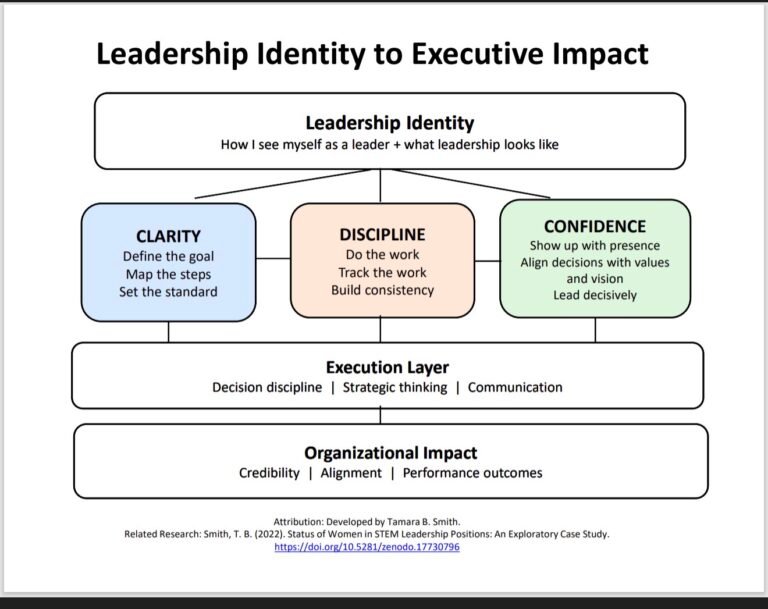
Confidence is not step one
Clarity comes first because it defines the goal, maps the steps, and sets the standard. Discipline is the bridge between clarity and consistent execution. It is built on steady cadence and measurable progress. Confidence shows up when actions align with values and vision, reinforced by presence and decisive leadership.
Foundation: This model builds on leadership identity, the internal foundation that shapes how leaders think, decide, and show up. Read Leadership Identity: Who We Believe We Are as Leaders for the deeper identity layer.
1. Clarity
Clarity is the starting point. It removes guesswork and reduces reactive leadership.
- Define the goal. State the outcome in plain language. Name what success looks like.
- Map the steps. Identify the sequence. Assign ownership. Set checkpoints.
- Set the standard. Decide what “good” standard looks like before execution starts. Define expectations for quality, pace, and accountability.
Clarity creates direction. It also creates alignment. People can follow a leader who is clear. When expectations are unclear, performance suffers. Gallup reports “knowing what’s expected” links to outcomes like productivity and retention across a very large dataset of teams and business units.
2. Discipline
Discipline is the execution engine. It turns intent into repeatable results.
- Do the work. Take the actions you committed to, even when it is inconvenient.
- Track the work. Use simple metrics, milestones, and follow-up routines. What gets tracked gets finished.
- Build consistency. Make execution predictable. Close loops. Reinforce habits that produce outcomes.
Discipline is not intensity. It is structured behavior over time. Use “if-then” plans to reduce friction. Example: “When I finish the meeting, then I write the follow-up email.” Research on implementation intentions describes this exact structure and links it to action initiation, repetition, and habit formation.
3. Confidence
Confidence is the visible result of clarity and discipline. It shows up as presence, composure, and decisive leadership.
- Show up with presence. Stay calm. Communicate clearly. Hold the room without forcing it.
- Align decisions with values and vision. Make choices that match the organization’s direction and your leadership standards.
- Lead decisively. Commit to the call. Communicate it. Execute it. Adjust when the data changes.
Confidence does not mean perfection. It means steadiness and follow-through. Confidence overlaps with self-efficacy in the leadership literature. In my dissertation, I draw on Bandura’s self-efficacy theory, which links beliefs about capability to confidence, motivation, and behavior.
Apply the Model
Use the model to locate the breakdown fast:
- If people feel confused, the gap is usually clarity.
- If progress stalls, the gap is usually discipline.
- If leadership presence feels inconsistent, confidence is being asked to carry what clarity and discipline should be doing.
Confidence becomes visible when clarity and discipline remain stable. The leader then becomes predictable in the best way. Organization can gain trust, alignment, and improved performance from this effect.
Execution Checklist
- Write a one-sentence outcome for your top priority this week.
- List the next 3 steps. Assign an owner and a due date to each step.
- Define the standard for “done” and the standard for “good.”
- Block two checkpoints on your calendar to review progress.
- Track one proof metric that shows movement: time, output, quality, or risk.
- Close one loop you have been avoiding: a decision, a follow-up, or a hard conversation.
- Before you decide, name the value or vision the decision must protect.
- Communicate the decision with one clear next step and one clear expectation.
Clarity sets direction. Discipline sustains execution. Confidence becomes visible after consistent follow-through.
Sources
Fida et al. (2025). Self-efficacy and nontask performance at work. A meta-analytic summary. https://doi.org/10.1016/j.paid.2025.113179
Gallup (Jan 22, 2024). In New Workplace, U.S. Employee Engagement Stagnates. https://www.gallup.com
Smith, T. B. (2022). Status of Women in STEM Leadership Positions: An Exploratory Case Study [Zenodo]. https://doi.org/10.5281/zenodo.17730796
Trenz, N. & Keith, N. (2024). Promoting new habits at work through implementation intentions. https://doi.org/10.1111/joop.12540